
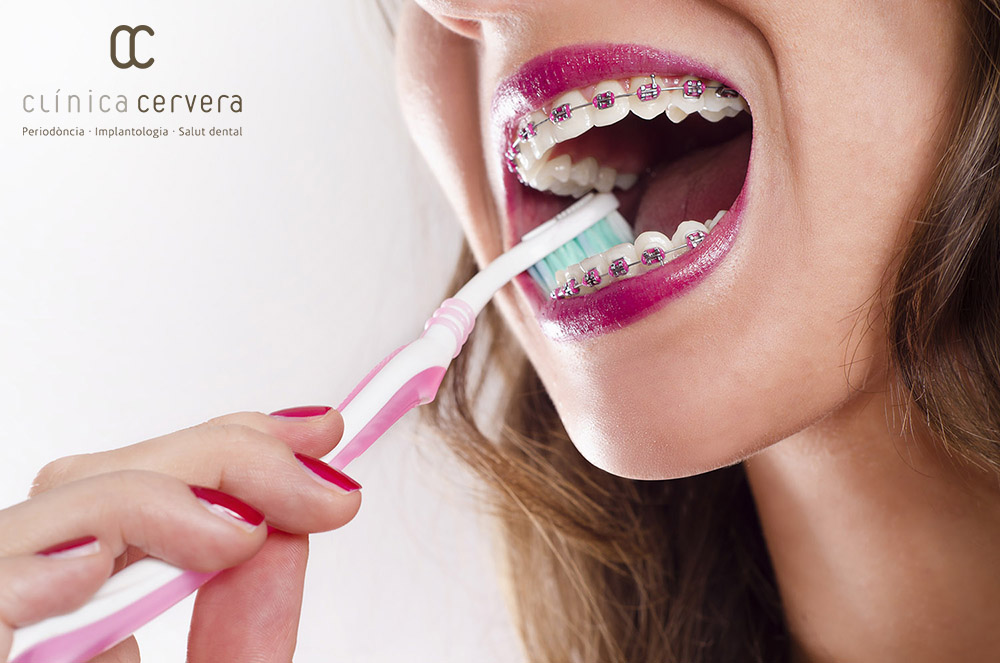
Oral hygiene tips for people with fixed orthodontics. Which tools are necessary and which are secondary?
Having a flawless smile is a gift, but also a great responsibility.
If you have chosen to get fixed orthodontics to improve the aesthetics and functionality of your mouth, your orthodontist will have already explained to you that you will have to pay close attention to your oral hygiene.
What hygiene guidelines will you have to follow?
Which tools are really necessary and which are optional?
Our orthodontic specialists give you the keys: Contrary to what many people think, orthodontic appliances do not cause cavities.
However, it is true that fixed orthodontics makes it easier for food to get trapped between the teeth and the appliances and for bacterial plaque to form, which if not removed correctly could lead to the appearance of permanent white spots (decalcifications), tooth decay, gingivitis (inflamed gums) and bad breath.
What is necessary to practice good hygiene What is really necessary to practice good hygiene if we wear fixed orthodontics is tooth brushing and interproximal cleaning.
Toothbrushing.
We should brush our teeth three times a day for at least 2 minutes.
A small-head brush, manual or electric, of soft or medium hardness, will help us reach all corners.
We can also use a specific orthodontic one, with a “V” shape, adapted to the row of brackets.
We must follow the following process: We remove the elastics and removable parts of the device (if it has any).
We clean the teeth one at a time, gently, both the inner and outer surfaces, without forgetting the palate and tongue.
We must pay close attention to the area between the brackets and the gum.
Interproximal cleaning.
To have complete hygiene we must clean the small holes that remain between brackets, teeth and arches.
For this reason, at least once a day, we will use interdental brushes or soft picks and dental floss.
If we cannot reach some areas, we could use super floss (with stiff ends that facilitate access to the most inaccessible corners) or flossing arches.
Complementary tools that can help us There are complementary tools that can help us perform even better oral hygiene, such as mouthwashes to strengthen the fight against bacteria; oral irrigators, to reach hard-to-reach places; and plaque detectors, to easily check which areas we have brushed well.
If you have any questions when performing oral hygiene with fixed orthodontics, do not hesitate to ask your orthodontist.
He or she will be able to explain the technique that best suits you and your type of orthodontics.
Remember that the result of orthodontic treatment also depends largely on the oral hygiene you perform at home.