
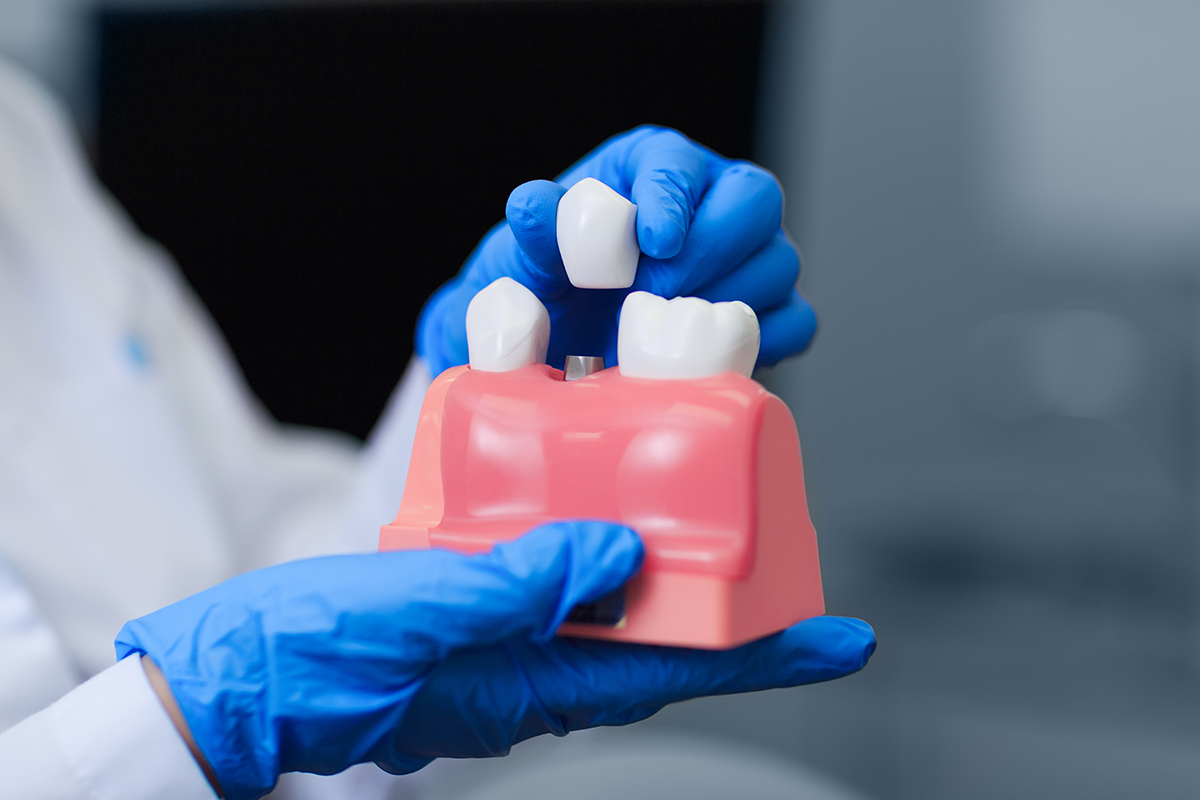
Implants, bridges or “dentures”: Which is the best dental prosthesis?
We explain why it is important to replace a lost tooth and what is the best option to do so. The loss of a tooth causes negative consequences beyond aesthetics.
Fortunately, today we have dental prostheses to replace lost teeth.
There are fixed and removable (“put in and take out”), with different characteristics and advantages, implants, bridges, “dentures”… What is the best dental prosthesis?
What is the problem when a missing tooth is not replaced?
Losing one or several teeth and not replacing them will create problems with chewing and the health of our mouth, in addition to spoiling our smile.
For example, it will cause adjacent teeth to tend to occupy the free hole and end up moving and separating, also making it easier for bacterial plaque to accumulate between them.
Therefore, replacing the lost tooth is not only important, but also urgent.
If we delay restoring it, the neighboring teeth will occupy part of the space and more complex and costly prior treatments will be necessary to place the dental prosthesis.
What does dental prosthesis consist of?
This is the name we give to a device or piece that is custom-made for each patient to replace or restore lost teeth.
They are fixed in the mouth to partially or completely complete the missing teeth in a jaw.
Generally, there are two types of prostheses: fixed and removable (“put on and take off”).
Types of dental prostheses a) Removable prostheses We can easily remove and put them on ourselves.
They are usually simpler to make and more economical.
There are: Resin, which are usually used as a temporary option, while our mouth is being treated for other problems before moving on to a fixed prosthesis.
It is what we commonly know as “dentures”.
Skeletal (metallic).
More stable and comfortable than resin ones. b) Fixed prostheses They are more aesthetic, with a more natural appearance.
They can be: Tooth-supported, known as a “dental bridge”.
They fill spaces by supporting themselves with neighboring teeth, which will be previously cut (“filed”) and then covered by crowns or “caps”, which will hold the artificial teeth (pontics).
Implant-supported, better known as dental implants.
Through a surgical process, one or several implants are placed.
Not only is it the most advanced and aesthetic option of all, but also the most conservative since it is not necessary to cut neighboring teeth.
What is the best prosthetic option to replace teeth?
The support, firmness and comfort of fixed prostheses are superior to those of removable options, as they give us more security when chewing and speaking.
Whenever possible, a dental implant will avoid damaging adjacent parts.
However, the decision on the best prosthesis will depend on several factors, such as the particular characteristics of each patient.
Therefore, the best dental prosthesis is the one that your dentist recommends after carrying out an initial study and explaining the indications, advantages and limitations of each option.