
Orthodontic cases in crossbites Results of cases of child and adolescent patients treated by doctors Talló y Tribó of Clínica Cervera Crossbite is one of the most common problems, especially in children.
This consists of the fact that, when biting, one or several teeth in the upper jaw remain behind the teeth in the lower jaw.
Its origin can be dental (if the jaws are in the correct position but the teeth are tilted), skeletal (if the upper jaw is smaller than the lower) or mixed.
As is also the case with open bite, one of the most used methods to treat this crossbite pathology is orthodontics.
We show you the results of child and adolescent patients treated by our doctors Talló y Tribó.
Case 1 This 6 and a half year old patient presented three major problems:
##NUM##1.
Dental: severe lack of space.
##NUM##2.
Skeletal: maxillary hypoplasia (underdevelopment of the upper jaw bone).
##NUM##3.
Functional: mouth breathing.
Skeletal and functional problems were treated as soon as they were detected.
With this, the airways were widened, making nasal breathing possible, correcting the anterior and transverse crossbite, and significantly increasing the space for the permanent teeth to erupt.
Once the dentition had changed, the dental malposition was treated, which had gone from being a serious problem to a mild one.
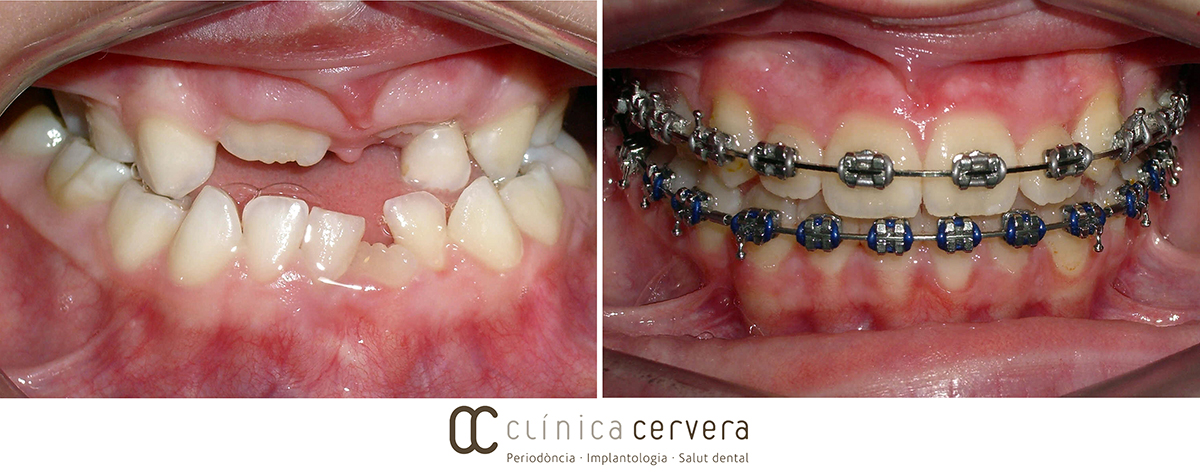
Case 2 The growth deficit of the upper jaw that this patient suffered from had caused an anterior crossbite that, if not treated in time, would have required surgical intervention to resolve.
Only four months of orthodontics were necessary to stimulate the growth of the upper jaw, resolve the crossbite and promote normal growth of the lower third of the face.
Case 3 This 8-year-old patient had a more pronounced inclination of the upper incisors towards the palate than necessary, since these should be slightly ahead of the lower incisors.
In this situation, the anteroposterior growth (from front to back) of the maxilla is slowed down and the malposition is perpetuated.
The objectives of the treatment performed are, therefore, to enable the maxilla to grow normally, prevent wear of the anterior teeth due to malposition, facilitate daily oral hygiene and improve the smile and also the patient’s self-esteem.