
We answer the questions our patients ask us about the Invisalign technique. If you’ve come this far, it’s because you’re interested in invisible orthodontics.
You’ve probably been thinking about correcting and improving your smile for some time, but the fact of wearing metal braces for a while has held you back…
Fortunately, today there are much more aesthetic brackets (sapphire or porcelain) or even lingual (located on the inner side of the tooth), although the most aesthetic and comfortable option of all is invisible or plastic orthodontics.
Below, we answer the 10 most frequent questions our patients have about this advanced orthodontic technique.
1. What advantages does invisible orthodontics have over traditional braces?
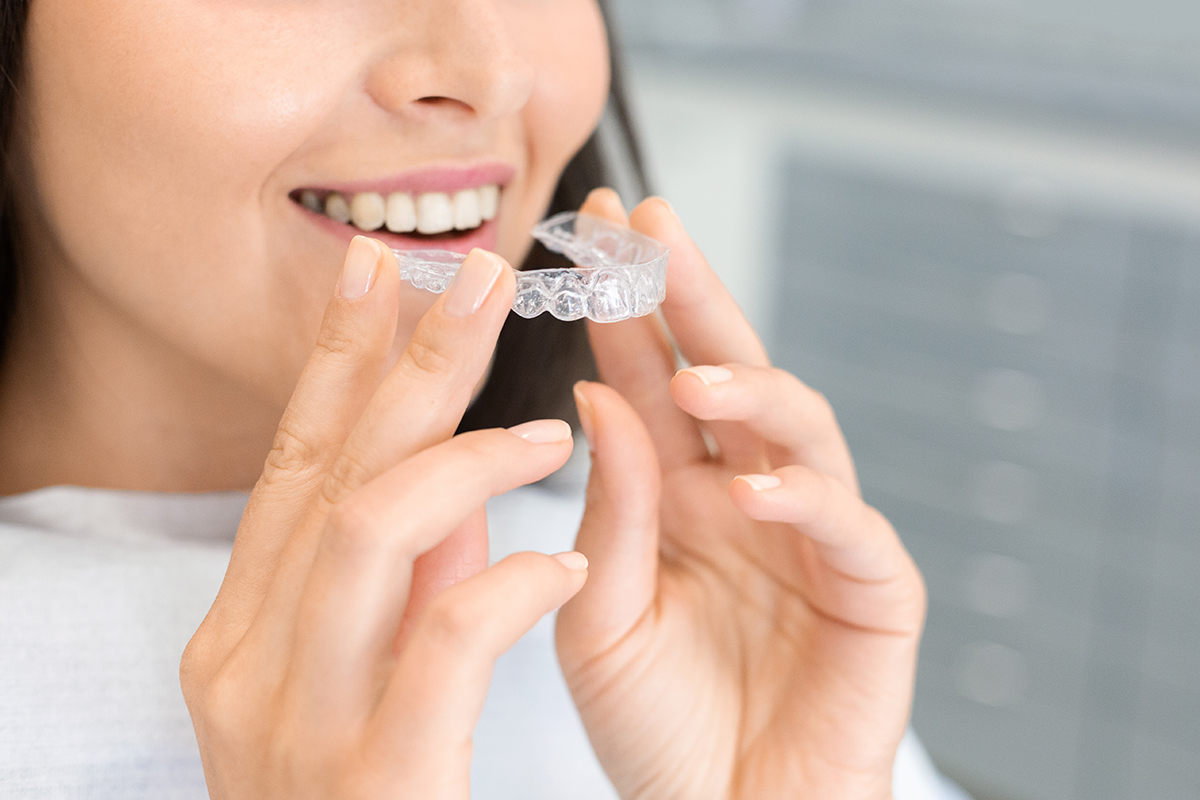
Invisible orthodontics is an orthodontic system with transparent, removable aligners.
This means that, apart from not being noticeable that we are wearing orthodontics, we can easily take them off and put them on.
Being “removable and removable”, it does not limit us when eating or brushing our teeth.
2. What does invisible orthodontic treatment consist of?
At the first consultation, our orthodontist studies your needs and carries out an orthodontic study through various tests (radiographs, photographs of the inside and outside of the mouth, 3D intraoral scanning, etc.) to finally establish the diagnosis and treatment plan.
The next step will be to “print” the first corrective aligners: transparent splints that are placed on the teeth thanks to small support points, also called “attachments”, which are imperceptible.
The aligners move the teeth in a controlled and previously programmed way, until they are placed in the intended final position.
Subsequently, we will schedule visits to change the aligners and monitor progress.
3. How long does it last?
As with any orthodontic system, the duration of treatment will depend on the needs of each patient, the initial malocclusion they present and their collaboration.
However, the orthodontist will tell you the estimated time and you will notice the corrections from the first few weeks.
4. Can everyone get invisible braces?
Although it is indicated for almost all types of patients, there are certain limitations depending on the type of malocclusion.
Also, it is very important to keep in mind that, even if this type of orthodontics is indicated in your case, it may not be the most suitable for you.
Choosing the best orthodontic system for your case will depend on many factors and it will be the orthodontist who will indicate the best option for you.
Finally, on certain occasions, invisible orthodontics could require auxiliary systems, such as microscrews, buttons, elastics… and even carrying out a brief phase with brackets to later begin or end the treatment with invisible aligners.
5. How many hours should I wear the aligners?
At least for 22 hours a day, and they are changed every week, as the teeth straighten.
You cannot eat or drink (except water) with the aligners in place and it is very important that your teeth are clean before putting them back in.
If you smoke, it is not advisable to do so with your aligners in place.
In a future post we will answer five more questions about this invisible orthodontic system: is the treatment painful? Does it affect the way you speak? Can I wear aligners if I have implants?, etc.
6. Is it painful?
At the beginning of each phase, when we put on a new aligner, it is normal for some people to notice some pressure on their teeth.
Although it is something that generally disappears within a couple of days.
7. Will it affect the way I speak?
It is not the most common, although we will need an initial period of adaptation since we will have a new element in our mouth.
This also happens with traditional orthodontic appliances.
8. Could I wear the aligners only at night or take them out for a special occasion?
It is not convenient.
For the success of the treatment, it is essential that we wear the aligners for a minimum of 22 hours a day, otherwise it will be less effective and the duration of the treatment will be delayed.
In the event of an exceptional event, you could remove your devices if you consider it necessary, but it is best to comply with the prescribed times.
Your commitment is key to the success of the treatment.
9. Can I wear Invisalign if I have implants or fillings?
In principle, dental implants and fillings are not limiting factors.
However, some dental bridges could offer resistance to the movement of the aligners, so the orthodontist will ultimately be the one to assess whether or not they could negatively affect the treatment in your case.
10. When the treatment is finished, will I need retainers?
When we finish the treatment, all the “attachments” (support points of the aligners) will be removed from the teeth and retainers will be placed to prevent the teeth from returning to their initial position.
These retainers will not be visible, as they are placed on the inner side of the front teeth.
In short, the great advantages of the Invisalign technique are that it is practically invisible and also removable, and therefore it hardly interferes with our social and work life.
Despite this, the success of orthodontic treatment does not lie in the technique used, but rather in the training and experience of the orthodontist.