
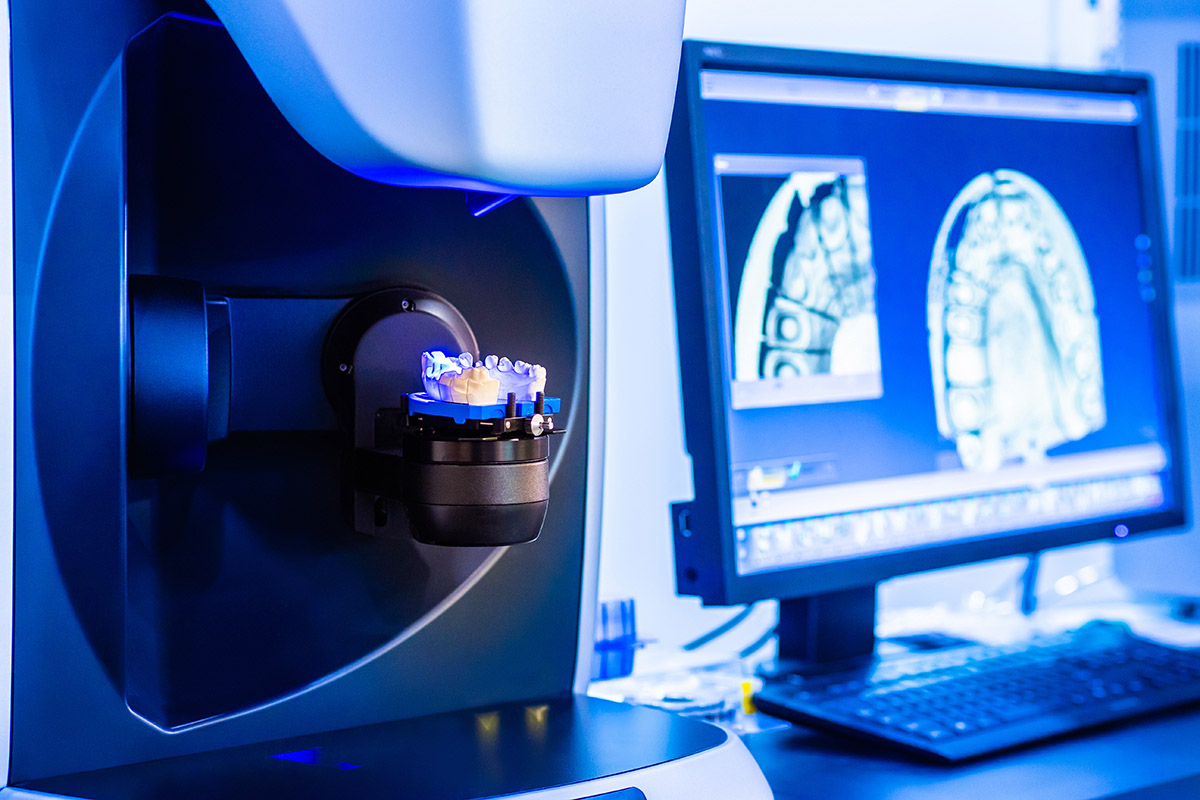
Advances that improve the patient experience Dentistry has evolved dramatically in recent years, thanks to the incorporation of new technologies that allow faster, more precise and comfortable treatments.
At Clínica Cervera, we are very pleased to be at the forefront of these advances, as it allows us to offer a quality service that responds to the needs of our patients.
From 3D printing to the use of artificial intelligence, technological tools are revolutionizing every aspect of dental care.
Below, we explain some of the most notable advances in this field.
3D printing: personalization and precision in treatment 3D printing has been one of the most revolutionary innovations in modern dentistry.
This technology allows the creation of custom dentures, crowns and aligners, with a millimeter precision that was previously difficult to achieve.
Unlike traditional methods, 3D printing allows dental pieces to be manufactured in a much shorter time and with a perfect adaptation to the patient’s anatomy.
This not only improves aesthetics, but also patient comfort.
In addition, 3D printing facilitates the creation of precise models to plan complex treatments, such as the placement of dental implants.
This reduces the margin for error and makes the process more predictable.
Digital dentistry: personalized planning for each smile Digital dentistry has transformed the methodology in which dentists plan treatments.
Tools like DSD (digital smile design) allow us to show our patients the final result of their treatment before it begins.
This type of planning is used so that a patient can see what their smile will look like after whitening, orthodontics or even laminate treatment.
And of course, this method not only increases patient satisfaction, but also improves the accuracy of the treatment, reducing the possibility of unforeseen events during the process.
Intraoral scanners: goodbye to invasive models One of the advantages most appreciated by patients is the intraoral scanner.
This device allows three-dimensional images of the oral cavity to be obtained quickly, comfortably and accurately, without the need for traditional models that are usually uncomfortable and unpleasant.
Thanks to intraoral scanners, we can create digital models of the mouth, which makes it easier to manufacture dentures, aligners and other dental devices with more accuracy.
Artificial intelligence: earlier diagnoses and more efficient treatments Artificial intelligence (AI) is revolutionizing dentistry, allowing earlier and more accurate detection of some oral conditions.
AI-based systems can identify problems before they become apparent.
This facilitates advanced intervention, avoiding complications and improving long-term results.
Beyond detection, AI optimizes treatment planning, suggesting personalized options based on patient data analysis.
But be careful, even if AI can recommend an efficient path, our judgment is still crucial, since only dentists can adjust the treatment taking into account factors such as the patient’s well-being, their medical history and their expectations.
The combination of artificial intelligence with human intelligence is key to guaranteeing the highest quality treatment.