
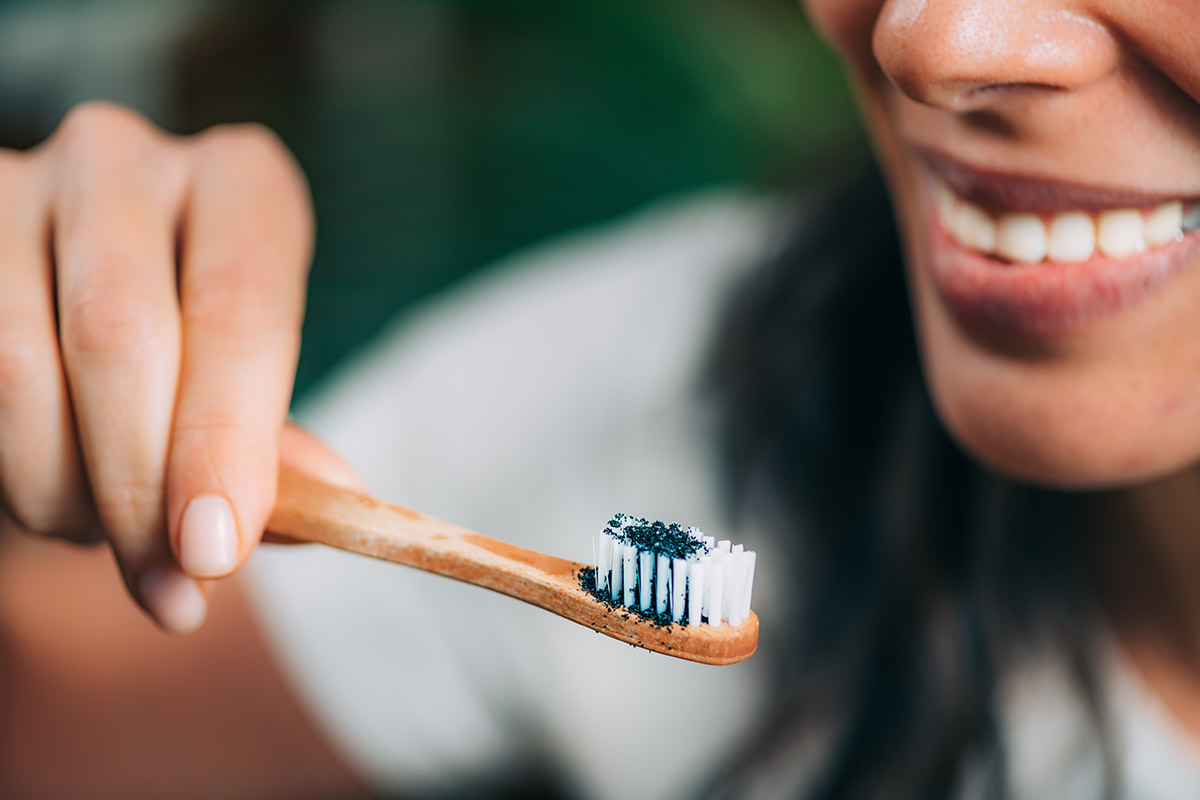
Activated charcoal or how to irreversibly end your tooth enamel This “miracle product” promises results that only professional whitening can achieve. Not all that glitters is gold and, in this case, what shines is activated charcoal: a “miracle product” that, according to many social media influencers, achieves tooth whitening with the same results as a professional.
However, scientific evidence tells us something very different… The use of activated charcoal on teeth can cause serious problems such as gum recession, enamel wear or increased tooth sensitivity.
We explain why: What is activated carbon?
It is a powder similar to common coal, extracted from wood, mines, oil or coconut shells, which has the capacity to adsorb chemical substances and toxins.
It is currently considered the best procedure to decontaminate the digestive tract in adults in cases of poisoning by drugs or toxins.
In these cases, activated charcoal is usually administered orally, either in capsules or diluted in liquids.
Does activated charcoal help whiten teeth?
Not only is it useless, it can be counterproductive.
As indicated by the Spanish Council of Dentists, activated charcoal powder “has a great abrasive capacity, it is like passing sandpaper over our teeth”, causing more harm than good:
##NUM##1.
Irreversible wear of tooth enamel.
Being abrasive, it wears away tooth enamel and exposes dentin, a darker layer that, therefore, dulls the shine of the teeth.
##NUM##2.
Tooth sensitivity.
As the enamel layer is reduced, the tooth is more exposed to external stimuli, such as cold or heat.
##NUM##3.
Gum damage.
Likewise, rubbing your teeth with an abrasive product can damage the gums and cause retraction.
Although activated charcoal fans claim that they notice their teeth becoming whiter, this is only an optical effect.
As the president of the Spanish Council of Dentists, Óscar Castro, points out, “you see your teeth black and when you rinse it gives the impression of having them whiter, obviously.
But the reality is that there is no whitening.”
On the other hand, the OCU points out that, apart from being a potentially harmful product for dental health, several manufacturers advise using it twice a day, which could make the consumer think that they can use activated charcoal as a substitute for traditional toothpaste.
How can I whiten my teeth safely?
Teeth whitening is a fairly common, effective and safe treatment.
But it should always be performed by a professional, as it may be contraindicated in some cases, such as in pregnant patients, with cavities, tooth sensitivity or periodontitis.
It is important to remember that, although many products advertise and promise miraculous tooth whitening, only whitening performed by professionals is effective and safe. + info: What is the right amount of fluoride?