
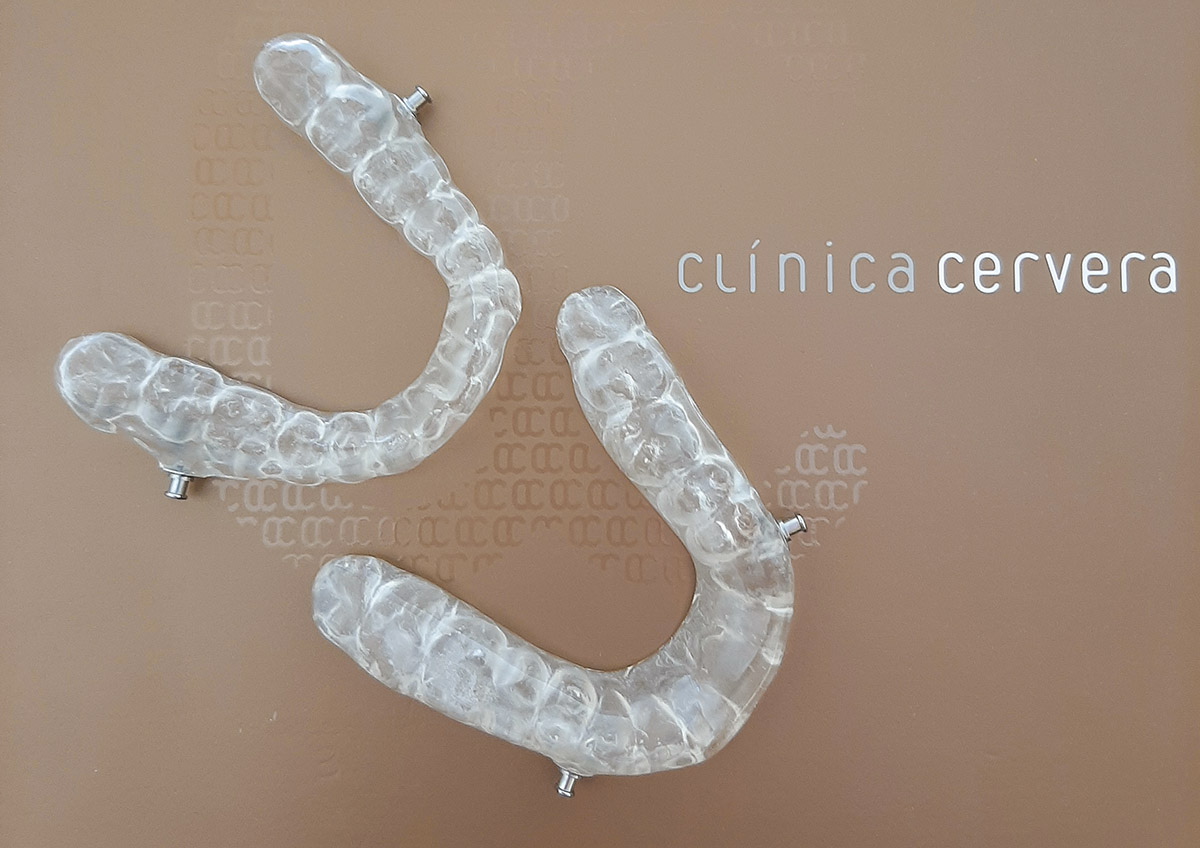
DAM: a small device that puts an end to snoring and mild apneas. The Mandibular Advancement Device is an effective treatment for these sleep-disordered breathing disorders. No problem should keep us awake, especially if it has a solution.
Snoring and mild apneas are sleep breathing disorders that affect the quality of our rest and that have an easy solution that fits in the palm of your hand: a Mandibular Advancement Device, better known as a DAM.
We explain what it consists of and how it works, and also what are the signs that alert us that we could be suffering from these respiratory problems.
The DAM or Mandibular Advancement Device is a custom-made oral splint, similar to those used in the treatment of bruxism, but double: one is placed in the upper jaw and the other in the lower.
Both fit together with an adjustable system that allows the jaw position to be advanced while we sleep to prevent the collapse of the upper airway and, therefore, facilitate the passage of air while we sleep.
In this way, we treat snoring and mild obstructive sleep apnea (OSA).
Like any dental treatment, DAM requires regular monitoring and adjustments so that it is effective and fulfills its function comfortably for the patient.
Snoring or apnea: what’s the difference?
Snoring and obstructive sleep apnea are disorders that sometimes occur at the same time, but they are different.
Snoring is the noise that occurs when the soft structures of the oropharynx vibrate during inspiration.
Apart from the collateral discomfort it may cause to those sleeping next to us, they do not usually pose a health risk.
On the other hand, obstructive sleep apnea is a serious disorder that causes our breathing to be interrupted for a few seconds and then resume.
This happens because the muscles in the back of the throat relax and the airways become narrower or close, causing a drop in oxygen in the blood.
In response, the brain sends a stimulus to wake us up and get the airways to open again.
How do I know if I snore or have sleep apnea?
Many people suffer from this type of problem without knowing it.
The Spanish Society of Neurology estimates that 90% of patients with sleep apnea are undiagnosed.
Dentists not only play an essential role in the treatment of snoring and apnea, but their early diagnosis is also important.
Therefore, if you wake up tired or a family member tells you that you snore or that you interrupt your breathing while you sleep, do not hesitate to discuss it with us so that we can help you.
Pay attention to the following alarm symptoms: Daytime Nighttime Sleepiness Snoring Fatigue Feeling short of breath Morning headache Insomnia Lack of concentration Need to urinate in the middle of the night (nocturia) Decreased libido Sweating Depressive mood Gastroesophageal reflux Sleep interruptions Although these symptoms may give you a clue that you are suffering from sleep breathing problems, it is your dentist who will really clear your doubts.
Diagnosis of snoring and apnea in the dental clinic At Clínica Cervera we have the most innovative technologies to carry out an accurate diagnosis: we evaluate the information through questionnaires, we carry out a specific clinical examination, a study of the airways and a respiratory polygraph, if necessary.
##BULLET##The study of the airways allows us to assess the volume of air available to each patient and rule out possible anatomical obstructions, which must be assessed by an otolaryngologist.
##BULLET##For respiratory polygraphy, the patient sleeps at home with a device placed on the chest that records 7 basic baseline parameters.
The device monitors sleep quality throughout the night and allows us to diagnose and plan the appropriate treatment.
Is DAM indicated for patients with CPAP?
Apart from snoring and mild obstructive sleep apnea, the Mandibular Advancement Device is also indicated for those people with apnea who cannot tolerate the CPAP (Continuous Positive Airway Pressure) air compressor, which produces constant positive pressure to keep the airway open.
Sometimes this type of device does not fit well or causes unwanted side effects, or is simply uncomfortable for those people who have to travel frequently and prefer a much smaller and easier-to-use solution, such as the DAM.
If you suspect that you may be suffering from any of these sleep breathing disorders, do not hesitate to consult your dentist.
Don’t let them steal your sleep or your health.